
Friday, May 4, 2018
Testing, Testing
I left here nearly five years ago. And now, I am not arriving, again, but perhaps doing a fly-by or sail-by.


ubuntu
According to Michael Onyebuchi Eze, the core of ubuntu can best be summarized as follows: “A person is a person through other people strikes an affirmation of one’s humanity through recognition of an ‘other’ in his or her uniqueness and difference. It is a demand for a creative intersubjective formation in which the ‘other’ becomes a mirror (but only a mirror) for my subjectivity. This idealism suggests to us that humanity is not embedded in my person solely as an individual; my humanity is co-substantively bestowed upon the other and me. Humanity is a quality we owe to each other. We create each other and need to sustain this otherness creation. And if we belong to each other, we participate in our creations: we are because you are, and since you are, definitely I am. The ‘I am’ is not a rigid subject, but a dynamic self-constitution dependent on this otherness creation of relation and distance”. [Wikipedia]
- Eze, Michael Onyebuchi. (2010), 190-191. Intellectual history in contemporary South Africa. Palgrave Macmillan. ISBN 978-0-230-62299-9.
Wednesday, July 31, 2013
Ode to Frankie
Frankly speaking,

Go away!
Don't come again another day!
Wait, wait!
Is that a pet, a generous rub, coming my way?
Perhaps, just perhaps, my interest is peaking!

Thursday, March 28, 2013
From Here to There
Dreams Do Come True
Change can be rapid. Catch your breath; it is here.
From here . . .

To here . . .

To here . . .

A dream comes true.
Wednesday, June 20, 2012
Aha Azahar!!
It is Tuesday, full of cool winds and peopled streets. La Eslava and its off-menu tapas beckon. A glass of Ribera del Duero first. What next? Delicias waft past, too quickly to identify. A chalkboard menu flirts with possibilities. Outside, the camarero trails an eager appetite; an outstretched hand points to this, to that.
Inside, a back-lit English voice suggests costillos con miel. Conversation follows--short histories, reasons for being in Spain, business cards. A downward glance reveals one more delicia: azahar-sevilla! Face, voice, person to a much read blog on things sevillano. ¡Fortuito!
An elusive morsel, fate reveals contents and flavors, slowly, richly. ¡Buen provecho!
Wednesday, June 6, 2012
Carmen
A recycled bar across the street buzzes. It is raucous white noise above the plummeting whine of motos and coches. Slapping, staccato steps on cobblestone open the scene. A woman's shouts erupt and echo along the street. Feet and voice advance. "Puta!" she bellows. Her voice and feet bear down. It is a chase told through counterpoint. Opera, unseen but heard.
Sunday, June 19, 2011
Carmona
Strategic. Carmona, a rook, in Spain's chessboard history. A natural escarpment overlooking, controlling the fertile fields and navigable rivers beyond. To the south, one weak point secured by Carthaginians to Romans to Spaniards with fortified walls--sticks, stones and bones. At the far end, a crematorium still scorched by the fires of Roman dead.


Raining in Spain
June 6. Rain! Thunder rolls across rooftops, punctuated by bolts of lightning. I am not the tallest point by many meters. I linger in the cool air. It will not last the summer.
Calatrava's bridge and the Torre de los Perdigones just outside the old city perimeter offer better strikes, the tower's camera obscura able to capture but not record such a blinding hit.

I imagine hailstones falling in the warm Sevilla air, climatological perdigones (musket pellets) roundng as they drop from such great height.
Thursday, June 9, 2011
Papiroflexia o Pinturas Andaluza
The Bellver Collection evokes the Andalucia of Carmen, its paintings by her native and not-so-native sons fill the walls of two galleries at the Museo de Bellas Artes de Sevilla. Romance, in the art history sense--señoritas flashing dark eyes from behind their mantillas and abanicos (fans). Zurbarán, Becquer, Murillo, Gonzalo Bilbao. . . Iterations of popular culture well into mid-century modern.

A museum guard mans the desk at the entrance, folding minute pieces of paper. Origami nazarenos. Costumbres populares. Paper folded, formed.

A museum guard mans the desk at the entrance, folding minute pieces of paper. Origami nazarenos. Costumbres populares. Paper folded, formed.

Saturday, May 28, 2011
Pistola de Fumar
She is dressed casually but carefully, her jeans and red blouse precisely creased. Her nails and hair speak of frequent applications of color, again considered and tasteful.
Alone, she sits at the small aluminum table, an extension of the café into the Plaza San Lorenzo next to the Basilica de Jesus de Gran Poder. Stacked and shuffled in front of her on the table are three packages of unfiltered Marlboros and a lighter. She opens a pack, slides out a cigarette and places it between her lips where it remains as she lights it and puffs continously on it with deep but rapid draws, the oily dark smoke clouding the air in front of her and bathing her tanned face.
When the cigarette is one-quarter ash, she anchors it between the fingers of her left hand and begins the rhythmic sweep of hand to mouth and down to flick the ashes on the rapidly shortening cigarette.
As the cigarette sweeps downward, her lips move in a silent mantra. To the mouth, long drag and then down with a flick to punctuate the cigarette´s upward sweep. Again and again.
This meditation on and of death continues through five cigarettes with only infrequent pauses to glance at her watch and a retrieval of four more packs of cigarettes from her purse in her lap.
No surcease, no redemption with Spain´s banning of smoking in interior public spaces. Each sweep of her hand is a prayer to nicotine's balm and a kiss to its faustian bargain.
Sunday, May 22, 2011
Arrivals
Arrivals come in many guises--advents of adventure, trepidations of newness, certainties of familiarity. A third summer in Sevilla parses each complexly. Words, phrases, and conversations dust off more readily; cultural timidity bows to personal urgency. Language and its acquisition are thought and action, noun and verb this summer. Bienvenidos á España!
Tuesday, July 6, 2010
To Market, To Market
An open-air market, filled with sights, sounds, and smells of everything fresh, unfolds each morning. It is the season of brilliantly red tomatoes (tomates) at 1,90 € per kilo, truthfully delicious cherries (cerezas), glossily purple eggplants (berenjenas), and radiantly yellow lemons (limones). Shopping is personal, and purchases are quickly and skillfully wrapped in cones of heavy craft paper for the journey home. Pointing is easy; knowing all the names gets easier.

This day's dinner consists of white beans (alubias) like grandmother used to make (al estilo de la Abuela; canned, yes, but excellent!) with small sausages (parrillada minis) including goat and pork sausage (criollo y longaniza), spicy sausage (chorizo picante) and blood sausage (morcilla). So much better than the pork 'n beans Campbell's still makes!


This day’s lunch includes beets (alas, remolachas proves elusive) and shrimp (gambas). And, a fish by any other name, and shape, and size--still intimidating, still fishy.

This day's dinner consists of white beans (alubias) like grandmother used to make (al estilo de la Abuela; canned, yes, but excellent!) with small sausages (parrillada minis) including goat and pork sausage (criollo y longaniza), spicy sausage (chorizo picante) and blood sausage (morcilla). So much better than the pork 'n beans Campbell's still makes!

Thursday, July 1, 2010
Llegar: To Arrive
The apartment is an IKEA showroom—neo-minimalism—living room to kitchen to bedroom to bath. It is enough. White walls and marble floors suggest coolness even as the temperatures begin to climb. Mosquitoes, vestiges of the rainy winter and spring, somehow elude the breezy, net curtains draping the full-length windows that open onto tiny balconies. Sounds visit from windows stationed ear-to-ear, eye-to-eye, dogs barking, flamenco guitar drifting, babies crying; Sevilla is a city, after all.
Home, this month, is the Macarena neighborhood, Sevilla’s SoHo or Austin, stretching out along the Alameda de Hercules, a former stretch of the rio Guadalquivir now paved for pedestrians and sprouting water spouts to cool the air and the pavement. Dogs and naked little children run through the gentle founts; older children fill water balloons and water cannons at public spigots.

Still, it is paradoxical, this barrio of free spirits. The Basilica of the Macarena stands at a refurbished gate into the ancient city, an intact remnant of the city walls stretching to the east and then south.


Spirit and property of this hermandad (including the Macarena) survive the civil war intact. Nationalism flavors their rhetoric, highlighted by the burial of Franco’s brother in the Basilica itself, an uncommon burial for a common, lay soldier. The penitentes’ hoods offer striking and unsettling reminders of another group dedicated to intolerance.
Home, this month, is the Macarena neighborhood, Sevilla’s SoHo or Austin, stretching out along the Alameda de Hercules, a former stretch of the rio Guadalquivir now paved for pedestrians and sprouting water spouts to cool the air and the pavement. Dogs and naked little children run through the gentle founts; older children fill water balloons and water cannons at public spigots.

Still, it is paradoxical, this barrio of free spirits. The Basilica of the Macarena stands at a refurbished gate into the ancient city, an intact remnant of the city walls stretching to the east and then south.

The Macarena, the Virgin of Hope, lives in the Basilica, zealously guarded by her chartered hermandad (fraternity charged with the Church’s Samaritan work, and the preservation and veneration of the Macarena). Her crystal tears trace a path of sorrow down her polychrome wood face. The museum, adjacent to the 19th-century basilica, showcases the paso (float) on which the Macarena is carried through the streets of Sevilla to the Catedral and back again. Another paso depicts Pontius Pilate pronouncing the death sentence, life-size figures filling this portable diorama of piety, betrayal and admonition.

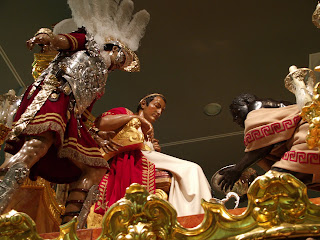


The hermandad find new vigor in the 20’s and 30’s. One Sr. Rodriguez Ojedo re-envisions the procession to grander heights of theater. New costumes for the processors in the form of Roman soldiers with breastplates, new trousseau for the Macarena, encrusted with hundreds of hours of gold and silver threaded embroidery covering acres of flowing velvet cloaks and gowns.

And, new cloaks and knotted capes for penitents, velvet hoods that cover the face except for the eyes and that tower to a single, sharp point.

And, new cloaks and knotted capes for penitents, velvet hoods that cover the face except for the eyes and that tower to a single, sharp point.

Spirit and property of this hermandad (including the Macarena) survive the civil war intact. Nationalism flavors their rhetoric, highlighted by the burial of Franco’s brother in the Basilica itself, an uncommon burial for a common, lay soldier. The penitentes’ hoods offer striking and unsettling reminders of another group dedicated to intolerance.
Monday, June 21, 2010
Leaving
A plastic shopping bag dances around the jet. Baggage handlers and pilot on inspection focus on tasks; we focus on engine air intake and wait. A large red bag and a large black bag escalate into the hold. Sevilla waits for us at the end of 14-hour travel.


Saturday, June 12, 2010
Silence
A year slips by. Words and cadences hover under the surface. Spanish! Well-thumbed pages and broken spine spring to life, a new backbone stiffens resolve--mine and the dictionary's.
Sevilla beckons.

Sevilla beckons.
Friday, July 31, 2009
Spanish Dictionary
The Spanish/English dictionary no longer tags along in my purse— instant access, tangible answers to unraveling the unknowns of Spanish. Well-thumbed pages and separated binding witness its use. Cheat sheets of verb conjugations struggle to find their place in unglued pages.


This summer of Spain is over. But annotations for my dictionary of Spain still pend, harder now with a keyboard bare of accented vowels.
¿Quién sabe que aventura viene próximo?
This summer of Spain is over. But annotations for my dictionary of Spain still pend, harder now with a keyboard bare of accented vowels.
¿Quién sabe que aventura viene próximo?
Thursday, July 23, 2009
Música en Los Jardines del Real Alcázar
I enter the gates of the gardens of the Alcázar, resigned to the bothers of open-air concerts--mosquitoes, heat, traffic noise. My list is long and personal.
Inside, I feel a manton of peace settle around me. Tranquilo, as C says at the house. The gardens work their magic.
Música Prima takes the stage, and the city melts away. There is only this--clear sky, cooling winds swaying the sky-sweeping palm trees, and music from the Middle Ages.

It is the International Year of Reconciliation. Period instruments weave a fabric of music--Christian, Sephardic Jew and Islamic--distinct but nuanced by years of intwined existence. Strings and percussion carry the notes with familiar shapes and sounds; wind intrigues with mechanical rarities, organetto, a portable pipe organ, and zanfoña, a hurdy-gurdy.
Literal meaning takes shape as familiar words emerge here and there in explanation and lyric. It is the music itself, though, that transcends spoken word, a way of knowing through the centuries.
The church bell, when it finally tolls, loses it metallic harshness and drifts into the soft night air, an anonymous fourth to the group´s trio.
Inside, I feel a manton of peace settle around me. Tranquilo, as C says at the house. The gardens work their magic.
Música Prima takes the stage, and the city melts away. There is only this--clear sky, cooling winds swaying the sky-sweeping palm trees, and music from the Middle Ages.
It is the International Year of Reconciliation. Period instruments weave a fabric of music--Christian, Sephardic Jew and Islamic--distinct but nuanced by years of intwined existence. Strings and percussion carry the notes with familiar shapes and sounds; wind intrigues with mechanical rarities, organetto, a portable pipe organ, and zanfoña, a hurdy-gurdy.
Literal meaning takes shape as familiar words emerge here and there in explanation and lyric. It is the music itself, though, that transcends spoken word, a way of knowing through the centuries.
The church bell, when it finally tolls, loses it metallic harshness and drifts into the soft night air, an anonymous fourth to the group´s trio.
Monday, July 20, 2009
Cloudy, With No Chance of Rain
For an hour or six this morning, Sevilla´s empty blue sky greyed, hinting at the possiblity of rain. Was that a drop just now? Alas, only the condensate from the air conditioners overhead. Wewake from siesta to perennial azure.
Wednesday, July 15, 2009
El Parque de María Luisa
Between the Rio Guadalquivir and the Plaza de España lies El Parque de María Luisa, a multi-faceted green jewel in a much-paved city. Among the eucalyptus, palm and jacaranda trees I am Lilliputian, dwarfed by their height and girth. The colossal flora are emphemera of a different era, Sevilla´s breath, held in times of crisis and carefully exhaled in times of rebirth.

Originally, the gardens of the palace of San Telmo, patron saint of mariners, the Duchess of Bourbon gave them to Sevilla. They sat neglected until the city incorporated them into the grand setting for the 1929 Ibero-American Exposition--a showcase for the pavilions of the former Spanish and Portuguese colonies.
Fortunes rise and fall. The 1929 Ibero-American Exposition failed to generate the hoped-for economic boost for Spain and Portugal, opening as the stock market crashed. Revolutions and civil wars sent the park, once Sevilla´s only public park, into neglect again. It rises once more, a splendid setting for the museums that now occupy the former pavilions of the 1929 expostion.


A small gem emerges from the green, glimpses of azure and terracotta teasing through the shrubs. The tiled pool sits quietly among the eucalyptus, their leaves floating serenely on the water´s surface.


On a raised backdrop, a ceramic relief shows two caravels, their sails filled with wind. This small, outdoor room honors Los Hermanos Álvarez Quintero, Serafín and Joaquín, beloved writers of plays, dramas, and the quintessential zarzuela. Their works, extremely popular in the early twentieth century, a rebirth of Spanish theatre.

A small banner floats across the top of the relief, "Un mismo aliento impulsa las dos velas...."

A single breath pushes two ships....
In El Parque de María Luisa, I hear Spain, its breath soughing through the jacarandas, pushing this rebirth of its Andalusian heritage.
Originally, the gardens of the palace of San Telmo, patron saint of mariners, the Duchess of Bourbon gave them to Sevilla. They sat neglected until the city incorporated them into the grand setting for the 1929 Ibero-American Exposition--a showcase for the pavilions of the former Spanish and Portuguese colonies.
Fortunes rise and fall. The 1929 Ibero-American Exposition failed to generate the hoped-for economic boost for Spain and Portugal, opening as the stock market crashed. Revolutions and civil wars sent the park, once Sevilla´s only public park, into neglect again. It rises once more, a splendid setting for the museums that now occupy the former pavilions of the 1929 expostion.
A small gem emerges from the green, glimpses of azure and terracotta teasing through the shrubs. The tiled pool sits quietly among the eucalyptus, their leaves floating serenely on the water´s surface.
On a raised backdrop, a ceramic relief shows two caravels, their sails filled with wind. This small, outdoor room honors Los Hermanos Álvarez Quintero, Serafín and Joaquín, beloved writers of plays, dramas, and the quintessential zarzuela. Their works, extremely popular in the early twentieth century, a rebirth of Spanish theatre.
A small banner floats across the top of the relief, "Un mismo aliento impulsa las dos velas...."
A single breath pushes two ships....
In El Parque de María Luisa, I hear Spain, its breath soughing through the jacarandas, pushing this rebirth of its Andalusian heritage.
Subscribe to:
Posts (Atom)


 Posts


